
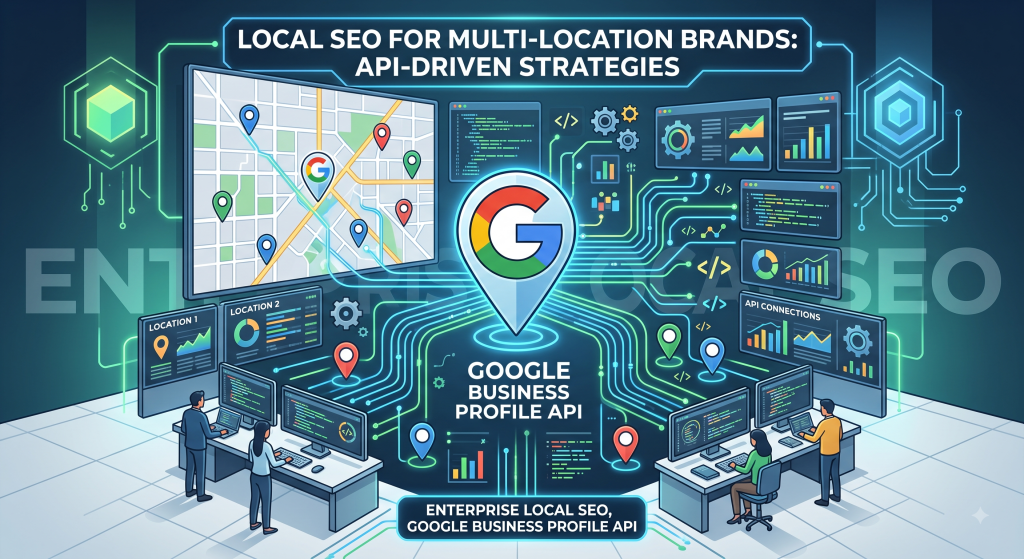
For enterprise brands with many physical locations, traditional local SEO workflows are ineffective. Managing Google Business Profile (GBP) listings through manual edits, spreadsheets, or disconnected tools often results in NAP (Name, Address, Phone) inconsistencies, outdated engagement signals, and fragmented performance tracking.
Google Business Profile has evolved from a static online directory into a live structured data feed. Today, GBP signals account for roughly 32% of Local Pack ranking influence and serve as the primary structured knowledge source for Google’s AI Overviews and real-time Gemini local answers.
To win in enterprise local search, SEO leads must stop treating profile management as a periodic marketing task and start treating it as a data engineering discipline. Here is how to build and execute an API-driven local SEO strategy for multi-location brands.
Within advanced technical SEO, empirical research on semantic web technologies is expanding the capabilities of search engines to parse and categorize data. Historically, adherence to the Schema.org vocabulary has served as the foundation for knowledge panel triggers and rich result eligibility. Recent algorithmic research and information retrieval studies, however, demonstrate a shift toward more complex and highly specific data structuring.
The advancement of structured data now depends on two emerging areas of technical research: the implementation of custom vocabularies and the architectural precision of deep nesting.
Why the Google Business Profile API is Non-Negotiable at Scale
At enterprise scale, the compounding cost of minor data discrepancies is severe. One outdated phone number, a missed holiday closure, or an unmonitored review can erode brand trust and trigger algorithm devaluations across entire regions.
1. The Real-Time Demand of AI & Search Algorithms
Google’s ranking algorithms and AI engines prioritize three core local signals:
- Data Freshness & Recency: Consistent updates to operating hours, local photos, and Google Posts signal an actively managed, open-for-business location.
- Granular Relevance: Secondary categories, exhaustive service menus, and detailed business attributes dictate whether a location surfaces for high-intent long-tail queries (e.g., “emergency pediatric dentist open now”).
- Engagement Velocity: Review response times (under 48 hours is the benchmark), review recency, and customer interaction patterns now account for nearly 20% of local pack ranking weights.
2. The Shift from Native Q&A to Gemini-Generated Answers
Google officially removed the native consumer-facing Q&A section and deprecated its API. In its place, Gemini AI dynamically answers customer questions in real time by synthesizing your business description, service lists, review text, owner replies, and website copy.
You can no longer manually script Q&A responses. Your only lever for controlling what Google’s AI says about your brand is programmatic profile enrichment—ensuring every data endpoint Google crawls is comprehensive, accurate, and structured.
Enterprise Local SEO Architecture: How Management Models Compare
When operationalizing multi-location local SEO, enterprise teams typically consider three models.
Feature / Dimension | Manual UI & Spreadsheet Bulk Uploads | Off-the-Shelf SaaS Platforms | API-Driven Data Infrastructure |
Update Latency | Hours to Days (prone to processing queues and human error) | 1 to 6 Hours (dependent on vendor sync schedules) | Near-Real-Time (direct OAuth 2.0 & webhook triggers) |
Data Customization | Low: Limited to standard spreadsheet template fields | Medium: Constrained by vendor UI and pre-built workflows | Unlimited: Programmatic control over every API-exposed field and attribute |
Cross-Channel Analytics | Siloed: Manual exports required for reporting | Siloed to Moderate: Vendor dashboards; limited BI exports | Unified: Automatic ingestion into BigQuery, Snowflake, or custom data lakes |
Scalability & Cost | Low: High human operational cost; breaks at >100 locations | Medium: Linear SaaS seat/location licensing fees | High: Highly automated; scales to 10,000+ locations with zero per-listing markup |
AI Overview Readiness | Poor: Infrequent updates lead to thin AI summaries | Moderate: Basic syndication of standard attributes | Advanced: Automated enrichment of services, attributes, and localized copy |
5 API-Driven Strategies for Multi-Location SEO
1. Single Source of Truth (SSOT) NAP & Special Hours Sync
Do not rely on store managers or marketing assistants to update hours during holidays, severe weather, or renovations.
- The Workflow: Integrate your Enterprise Resource Planning (ERP) or internal store-locator database directly with the GBP Business Information API (locations.patch endpoint).
- Execution: Configure an automated cron job or event-driven webhook that pushes address, phone, URL, and special operating hours adjustments the moment a change is flagged in your internal database.
- SEO Impact: Prevents customer complaints and negative behavioral signals caused by inaccurate hours—a critical ranking factor for queries with “open now” intent.
2. Dynamic, Localized Google Post Syndication
Google’s engagement algorithm favors profiles that publish fresh content one to three times per week. However, distributing generic corporate announcements across many profiles reduces local relevance.
- The Workflow: Use the GBP API to deploy templated, dynamically tokenized Google Posts at scale.
- Execution: Build a content scheduler that injects location-specific variables into post copy and calls-to-action (e.g., “Visit our [Neighborhood_Name] team on [Street_Name] for 20% off HVAC tune-ups this week”).
- SEO Impact: Increases click-through rates to localized landing pages and strengthens geo-relevance signals without manual drafting.
3. Closed-Loop Review Ingestion & Reputation Engineering
Review signals account for about 20% of local ranking factors, with recency and response speed being especially important.
- The Workflow: Instead of checking third-party inboxes, use the GBP API to stream reviews directly into your customer relationship management (CRM) platform, helpdesk (Zendesk, Salesforce), or Slack.
- Execution:
- Route 1-star and 2-star reviews immediately to high-priority customer recovery queues with automated SLA alerts.
- Provide local branch managers with “Manager”-level API access to draft personalized responses, while retaining “Owner” control at headquarters to protect core NAP and category branding.
- Pipe review text into Natural Language Processing (NLP) models to extract location-specific sentiment trends (e.g., identifying recurring parking or staffing complaints at specific branches).
4. Programmatic Attribute & Service Catalog Enrichment
According to local search data, over 86% of GBP views stem from category- and service-based discovery searches. Thin listings are ignored by both traditional algorithms and AI Overviews.
- The Workflow: Leverage the API to audit and populate every primary category, secondary category, structured attribute, and service item across your portfolio.
- Execution: Instead of using generic terms like “Plumbing”, programmatically add descriptive, keyword-rich service names (such as “24/7 Emergency Water Heater Repair”) with 100–200 character descriptions that align with your localized landing page copy.
- SEO Impact: Provides the deep semantic context Gemini AI requires to recommend your brand in conversational answers.
5. BigQuery & BI Pipelines for Local Attribution
Native GBP reporting dashboards provide limited historical data and cannot connect local search visibility with paid campaigns or offline store conversions.
- The Workflow: Connect the GBP Performance API to an automated ETL pipeline feeding into Google BigQuery, Snowflake, or AWS Redshift.
- Execution: Extract daily or 15-minute interval metrics—including keyword search queries, Maps vs. Search impressions, direction requests, website clicks, and phone calls.
- SEO Impact: Combine local search data with Google Ads and GA4 analytics to demonstrate enterprise ROI by measuring how organic local visibility affects lower-funnel acquisition in specific DMAs (Designated Market Areas).
Technical Governance & Implementation Checklist
To successfully deploy an API-driven local SEO framework, technical SEO leads and development teams should enforce the following governance standards:
- Implement Role-Based Access Control (RBAC): Structure your Google Cloud project permissions so that corporate HQ retains Owner rights over listing metadata (legal business name, primary category, verification status), while delegating Manager permissions to field tools for reviews, photos, and Q&A.
- Handle Rate Limits & Pagination Gracefully: The GBP API enforces specific quotas per project and per user. Design your synchronization scripts with exponential backoff and automated retry logic to handle rate-limit spikes during bulk multi-location pushes.
- Monitor Verification & Suspension States Programmatically: Set up automated webhook notifications to flag sudden listing de-verifications, suspensions, or unauthorized community edits immediately so SEO teams can intervene before traffic drops.
- Enforce Weekly Data Audits: Even with SSOT automation, schedule automated weekly diff checks between your internal location database and the live locations.get API responses to catch any unapproved third-party or user-suggested Google edits.
Future-Proofing Multi-Location SEO
Managing multi-location local SEO through spreadsheets and manual logins is now obsolete. As AI search prioritizes structured data, recency, and verified local prominence, brand visibility relies on robust data architecture.
Integrating the Google Business Profile API into your enterprise data stack allows SEO teams to prevent data decay, automate local relevance at scale, and enable cross-channel attribution that demonstrates the value of local search.