
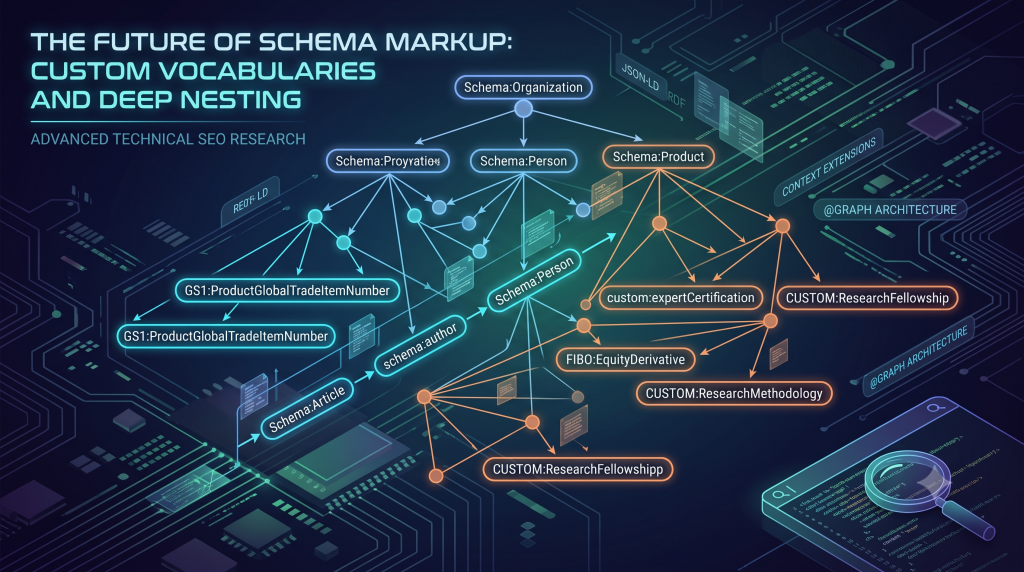
Within advanced technical SEO, empirical research on semantic web technologies is expanding the capabilities of search engines to parse and categorize data. Historically, adherence to the Schema.org vocabulary has served as the foundation for knowledge panel triggers and rich result eligibility. Recent algorithmic research and information retrieval studies, however, demonstrate a shift toward more complex and highly specific data structuring.
The advancement of structured data now depends on two emerging areas of technical research: the implementation of custom vocabularies and the architectural precision of deep nesting.
The Limitations of Standardized Taxonomies
While Schema.org offers a robust ontological framework, studies in semantic data mapping consistently highlight its limitations in highly specialized or technical edge cases. When information retrieval bots process a webpage, they attempt to map extracted entities to an existing Knowledge Graph. If the standard vocabulary lacks sufficient granularity, the engine must rely on natural language processing (NLP) to bridge the gap. This process introduces computational latency and increases the margin of error.
Recent research in semantic web architecture suggests that bridging this gap requires moving beyond the basic parameters of @type and standard properties, and instead adopting ontological extensions.
Custom Vocabularies: Extending the @context
The advancement of structured data depends on the adoption and integration of custom vocabularies through JSON-LD extension mechanisms. Although Google’s official documentation emphasizes standard properties, algorithm patent research and W3C semantic web whitepapers indicate that search engines are increasingly capable of processing custom namespaces when these are linked to established ontological graphs such as Wikidata or DBpedia.
Manipulating the @context array enables the merging of Schema.org with external vocabularies, such as GS1 for product data taxonomy or FIBO for financial industry metadata.
Key areas of research for implementation include:
- Ontology Mapping: Formally defining custom properties using the owl:equivalentProperty or rdfs:subClassOf frameworks to ensure search engines can contextualize the custom vocabulary against known entities.
- Machine Learning Integration: Evaluating how custom properties train industry-specific algorithms. Internal research and A/B testing on crawl logs show that highly specific, custom-defined nodes allow algorithmic classifiers to cluster sites more accurately within niche topical authorities.
Deep Nesting and the @graph Architecture
Historically, SEO deployments have often relied on flat, isolated JSON-LD snippets, such as standalone Organization and Article blocks. However, empirical research on data structures demonstrates that flat taxonomies are ineffective at communicating explicit entity relationships.
Deep nesting, particularly through the use of the @graph array, transforms structured data from a simple checklist of attributes into a comprehensive relational database of triples (Subject, Predicate, Object).
The Research-Backed Advantages of Deep Nesting:
- Entity Disambiguation: Nesting a Person entity as the author of an Article, which serves as the mainEntity of a WebPage published by an Organization, establishes a robust semantic chain. Research into Google’s entity resolution processes demonstrates that this approach significantly reduces entity ambiguity.
- Crawl Efficiency Data: Server log analysis studies indicate that deeply nested, centralized @graph structures reduce the computational load on parsers such as Googlebot. Consolidating all entities into a single interconnected graph array enables the crawler to construct the relational model in a single pass.
- Referential Integrity (@id): Advanced research in graph theory for SEO emphasizes the strict use of @id nodes. Defining an entity once and referencing its @id URI throughout the deeply nested structure eliminates redundancy and prevents the creation of duplicated or fragmented entities within the search engine indexing pipeline.
The Mandate for Empirical Testing
As search algorithms evolve from traditional keyword indices to complex neural networks, schema markup approaches must be grounded in data science and structured research. Speculative implementations should be replaced with rigorous testing.
The deployment of custom vocabularies and deep @graph nesting requires meticulous validation. Researchers and technical SEO practitioners should utilize tools such as the Class-a-schema validator and JSON-LD playgrounds to ensure syntactic accuracy, followed by rigorous log file analysis to measure the precise impact on crawl behavior and entity extraction. The advancement of semantic SEO depends on treating structured data as a field of continuous architectural research rather than a marketing checklist.