
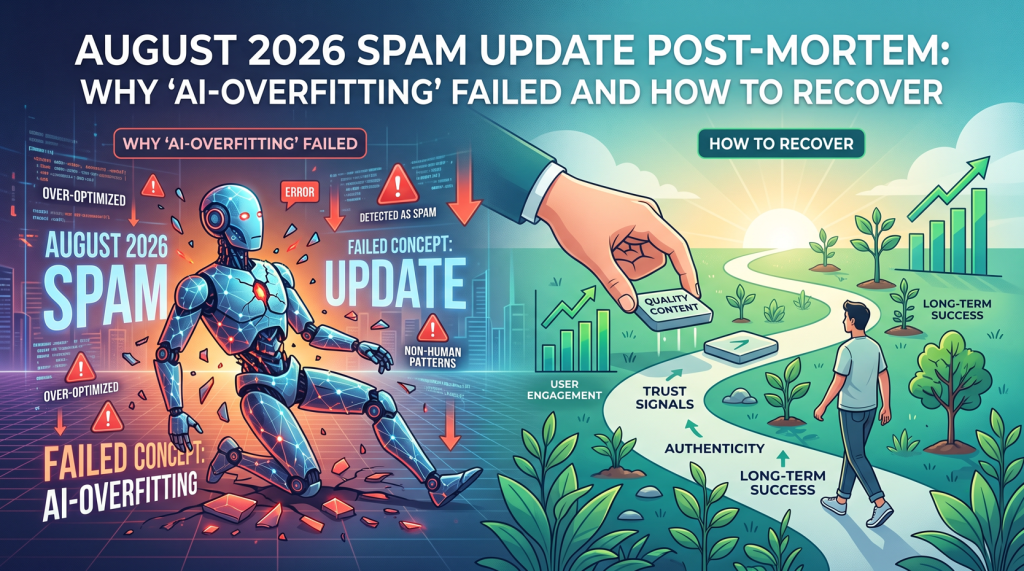
The third spam update in 2026 has now come to an end. Google launched its August 2026 Spam Update globally at 12:30 PM ET on August 18 and completed it at 4:50 AM ET on August 21. Although it was listed as a general spam update, the volatility footprint reveals a far more specific account of what actually happened.
The rollout focused heavily on websites that had over-engineered their architecture with the particular aim of manipulating real-time generative retrieval loops; this is referred to as generative engine overfitting. You probably experienced the effects if you had prioritized machine-readability over human-centered usefulness.
The following document provides a post-mortem analysis of the content that Google’s SpamBrain targeted, an explanation of how to diagnose the damage, and the precise framework required to recover your traffic.
Deconstructing “AI-Overfitting”: The New Target of SpamBrain
AI-overfitting happens when publishers remove the human touch from their content in order to make it too easily readable by machines. This is typically seen in the use of semantic stuffing in H1/H2/H3 tags, the inclusion of forced generative summary boxes, artificial co-mentions of entities, and excessive schema nesting.
Google has recently updated its spam policies so that efforts to deceitfully manipulate its AI Overviews or AI Mode are now considered spam and carry the same risk of being demoted as traditional cloaking or the use of scaled thin content. SpamBrain has improved its classifiers to identify this behaviour. Generic informational websites are currently losing a great deal of visibility to well-established sites in the same field since the generic sites do not have algorithmic trust filters or firsthand evidence. The practice of over-optimising your HTML using llms.txt files and artificial semantic anchors in order to trick Gemini into citing you has changed from being a smart strategy to becoming a structural liability.
Post-Update Diagnostic Workflow (Spam vs. Core Shifts)
Before you carry out a review of your content strategy, you should first establish whether your loss of traffic is directly the result of the August 21 Spam Update or if it is due to ongoing degradation caused by the core volatility in mid-summer. Apply the following three-step diagnostic framework:
- The Instant-Drop Analysis: Open Google Search Console (GSC) and check the Performance report for sharp, step-function drops occurring precisely between August 18 and August 21. A sudden cliff during this 72-hour window is a hallmark signature of SpamBrain automated demotions.
- Template-Level Isolation: Segment your performance by URL directory (e.g., /blog/ vs. /reviews/). If a specific programmatic template was flagged for scaled low-quality generation, the losses will be isolated to those specific folders rather than the entire domain.
- The Indexing Status Verification: Cross-reference the affected URLs using the GSC URL Inspection tool. Check if the demoted pages were fully de-indexed (dropped from the index entirely) or merely suppressed in ranking position.
Advanced Recovery Framework: Un-winding the Over-Optimization
If you’ve been affected by the spam update, it’s not enough simply to wait it out; you have to actively eliminate the structural bloat and reconstruct the helpfulness signals.
- Content Humanization & Proof Injection: Replace generic, AI-targeted summary boxes with original data points, real-world testing metrics, verified case studies, and distinct author perspectives. Information Gain is a requirement, not a bonus.
- Cleaning Structural Bloat: Audit your JSON-LD schema. Remove redundant, over-nested markup that contradicts or exaggerates the visible on-page content. Ensure your HTML delivers core value efficiently without relying on heavy client-side JavaScript hydration loops that delay parsing.
- Content Pruning Protocol: Consolidate your “Information Echoes.” If you have multiple thin posts answering the same intent, merge them into a single, comprehensive primary data node and implement clean 301 redirects.
The Fall 2026 Standard
The main lesson from the August Spam Update is that by the end of 2026 SEO will need a clean technical implementation together with clear evidence of genuine human authority. Rapid growth of AI-generated content without editorial controls is a mistake.
In order to secure your architecture, you should export your GSC performance data and compare the period from August 18 to 24 with the previous 4-week baseline. You must audit all pages that have automated summaries to verify that there is genuine Information Gain, and you should firmly remove any unverified or manipulated review and product schema in order to comply with Google’s new structured data guidelines.
Expert Value-Add Tip: Spam updates are fundamentally different from Core updates. When recovering from a Core update, it is often necessary to wait until the following wide-ranging core update (a process that can take months) before seeing any structural improvements, whereas SpamBrain refreshes take place on a much quicker and regular basis. By getting rid of your ‘AI-overfitted’ content and deleting those thin programmatic pages at this moment, you can expect recovery to take place during the regular automated refreshes over the coming weeks. It is essential to take immediate diagnostic action.