
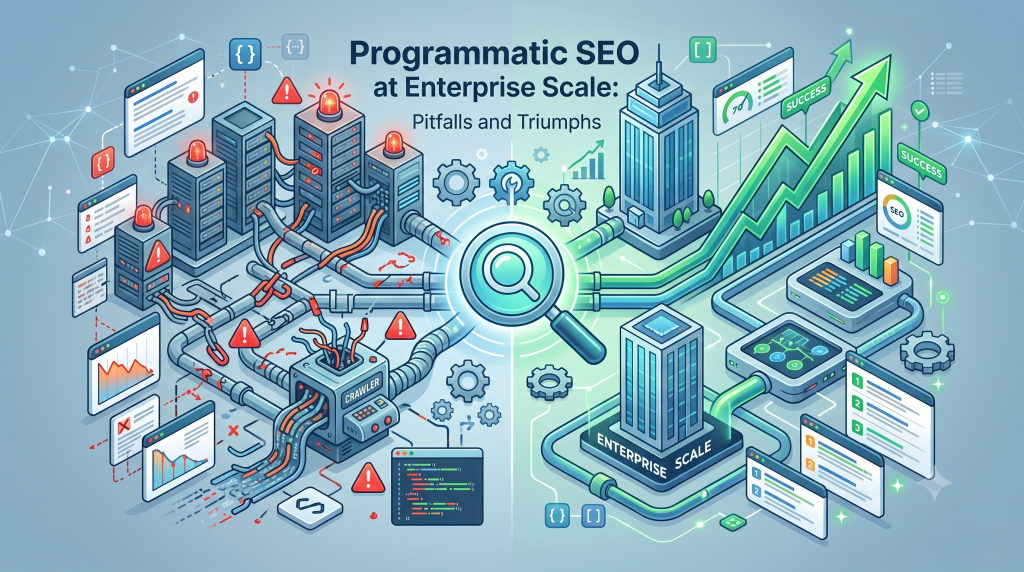
Programmatic SEO (pSEO) at the enterprise level has significantly evolved. By 2026, generating 50,000 pages by simply swapping variables in a generic template is not only ineffective but also likely to trigger a scaled content abuse penalty.
Leading agencies and enterprise teams have moved from mass page generation to programmatic content engineering. This approach requires comprehensive CI/CD integration, automated schema generation, and strong observability pipelines to manage complex architectures efficiently and without manual intervention.
Below are key successes of effective pSEO at scale, as well as critical pitfalls that can quickly undermine your organic visibility.
The Triumphs: Where Enterprise pSEO Wins
When implemented effectively, programmatic SEO enables organizations to capture highly specific, long-tail search intent that would be cost-prohibitive to target manually.
- Dominating Location and Attribute Queries: E-commerce and service sites can efficiently scale category and attribute combinations (such as Service + City or Product + Size + Material) to capture localized or highly specific search intent.
- Capturing AI Search Visibility: Traditional SERPs are only one aspect. Large-scale pSEO programs are well positioned to earn citations across platforms such as ChatGPT, Perplexity, Gemini, and AI Overviews. AI engines require precise entity markup. Automatically injecting structured data, such as FAQPage, Product, Article, and HowTo, during build time ensures these pages are indexable and easily cited by large language models.
- Automated Internal Linking: Manually curating internal links on sites with over 100,000 URLs is not feasible. Leading enterprise programs use semantic entity graphs to automate internal linking, creating intelligent topic clusters that surface deep programmatic pages, distribute PageRank efficiently, and prevent orphaned URLs.
Modern enterprise teams integrate SEO directly into engineering workflows to manage the deployment of thousands of pages. The following outlines a typical validation pipeline in 2026:
Key insight: Leading teams automatically fail deployments in CI/CD before production if a new programmatic template degrades Core Web Vitals, particularly Interaction to Next Paint, or if hreflang tags generate validation errors.
The Pitfalls: 4 Ways to Break Your Site at Scale
Programmatic SEO failures are rarely due to random errors. Most issues stem from broken infrastructure, insufficient data, or inadequate post-publish monitoring.
1. The “Thin Content” Dataset Trap
Thin content in pSEO is typically a dataset issue, not a template issue. If removing a modifier keyword, such as a city name or product color, leaves a page that reads as a generic template, the dataset lacks depth. Generating thousands of pages with minimal differences will be flagged by helpful content systems.
Solution: Add robust, unique data columns to your database, such as user reviews, localized pricing, or distinct technical specifications, instead of relying on generic filler text.
2. Cannibalization of Money Pages
It is easy to generate thousands of long-tail pages that unintentionally divert traffic, keyword rankings, and revenue from high-converting core pages. Without automated checks to confirm each programmatic page addresses a unique search intent, you risk diluting the SEO value built over years.
3. Silent Infrastructure Failures
At enterprise scale, missing internal links and broken canonical tags often go undetected. A single misconfigured canonical tag in a template update can remove 10,000 valid pages from the index overnight without visible frontend errors. Managing over 30 regional markets requires generating thousands of hreflang signals per URL. If these are not automatically validated against the sitemap during deployment, errors can accumulate, confuse crawlers, and harm international rankings.
4. Ignoring Core Web Vitals at Scale
Rendering heavy JavaScript frameworks such as React, Next.js, or Vue across tens of thousands of pages creates significant risk for Interaction to Next Paint (INP). If the programmatic infrastructure relies on unoptimized rendering without effective caching and clean code, search engines will quickly down-rank all affected pages.
The Rule of Scaled Deployment
The most significant risk is publishing all pages at once. Releasing 50,000 pages simultaneously can instantly replicate any systemic bug across your entire digital footprint before it can be identified and resolved.
Instead, use staged batching: launch 10 to 20 pilot pages, validate their indexing and early search console impressions, then scale to 100. Only deploy the full database once the template demonstrates viability. Programmatic SEO requires ongoing logfile analysis and automated observability, rather than a one-time launch.