
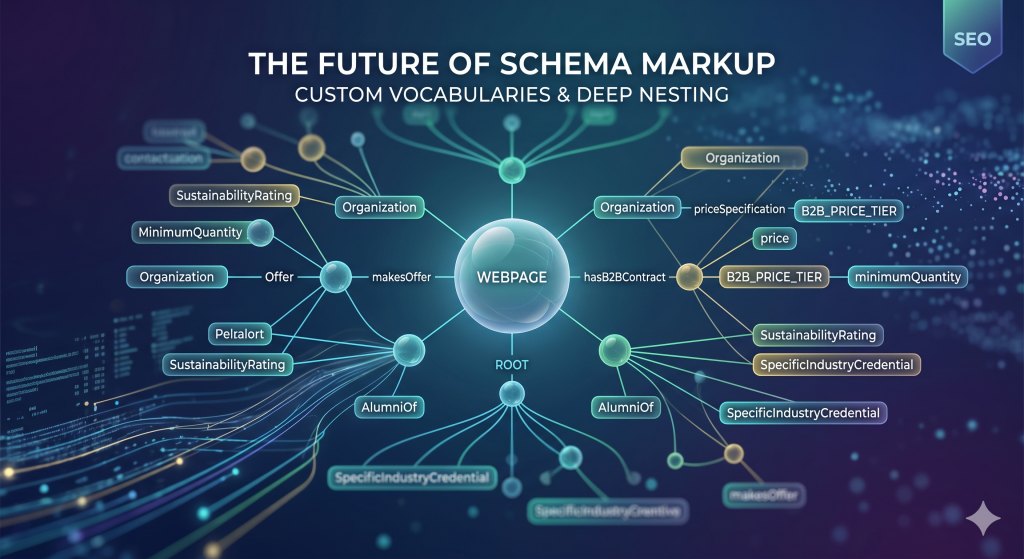
If you still view schema markup only as a tactic for gaining SERP features like star ratings or FAQ accordions, it is time to reconsider your approach.
In 2026, the conversation around structured data has fundamentally evolved. With the dominance of AI Overviews, agentic browsers, and Generative Engine Optimization (GEO), schema is no longer just an “SEO tactic.” It is the foundational semantic layer—the closed-loop Knowledge Graph—that AI systems rely on to understand, trust, and synthesize enterprise data.
To remain competitive, SEOs should move beyond flat, disconnected JSON-LD tags and adopt Custom Vocabularies and Deep Nesting for improved machine readability.
These advanced methodologies are essential for the modern web. The following explains their importance and how to implement them to ensure your digital presence remains relevant.
The Death of the “Comprehension Budget”
Large Language Models (LLMs) and AI search features operate within a limited comprehension budget. When AI encounters flat or fragmented schema, or none at all, it must infer relationships between entities such as the Person, the Article, and the Organization, which increases processing complexity.
If your data is ambiguous and exceeds an AI’s comprehension budget, the system will prioritize competitors with well-structured data. Deep nesting addresses this by improving crawl efficiency and ensuring clear entity relationships.
Deep Nesting: Building the Content Knowledge Graph (CKG)
Deep nesting involves structuring markup hierarchically by placing secondary entities directly under the primary entity of the page. Rather than using multiple independent schema blocks, you create a single, interconnected structure.
Why Deep Nesting Wins:
- Explicit Relationships: Deep nesting eliminates ambiguity by clearly defining relationships, such as an Organization creating a Brand, which manufactures a Product, associated with an Offer, supported by a Review, and authored by a Person.
- Logical Inferencing: Fully nested entities transform your web page into a machine-readable knowledge graph. AI systems can analyze this structure to derive new factual insights through logical reasoning.
- E-E-A-T Anchoring: Nesting Person (Author) and Organization (Publisher) under an Article or MedicalWebPage schema with @id nodes establishes a clear and verifiable map of digital authority.
Custom Vocabularies: Moving Beyond the Basics
Schema.org offers over 800 types and 1,400 properties, yet many SEOs limit their use to basic types such as WebSite, LocalBusiness, or Product.
As AI search becomes more specialized, standard vocabularies may not suffice, particularly for complex B2B, SaaS, or technical industries. Custom vocabularies and underused relational properties can provide a significant competitive advantage.
- Exploiting Relational Properties: Rather than creating new terms, leverage existing properties such as knowsAbout, alumniOf, areaServed, serviceType, and makesOffer to create detailed entity descriptions.
- Custom Namespaces: For specialized internal or B2B applications, define custom properties or extensions as needed. While standard Schema.org vocabulary ensures broad compatibility, integrating industry-specific ontologies, such as those in healthcare or manufacturing, enables AI systems to recommend your solutions more effectively.
- NLWeb & Agentic Readiness: AI systems are increasingly acting on behalf of users, such as booking flights or comparing software. Detailed schemas that specify subscription renewals, pricing rules, or product compatibility enable AI to integrate your data directly into its processes.
Implementation Mandates for 2026
To transform your schema from a superficial addition to a structural advantage, follow these guidelines:
1. Centralize with @id Node Linking
Avoid redefining the same entity on multiple pages. Define your main Organization once, assign it a unique URL identifier (“id”: “https://www.yourdomain.com/#organization”), and reference this @id node across all relevant pages. This approach unifies your site into a cohesive, cross-referenced structure.
2. Shift Schema Upstream
Schema issues are typically related to timing rather than code. Applying schema at the end of the content lifecycle only perpetuates existing structural issues. Schema architecture should be integrated at the template level and defined during the content strategy phase.
3. Validate for the Graph, Not Just the Snippet
Do not rely solely on Google’s Rich Results Test, as it only indicates eligibility for specific SERP features. Use the official Schema Markup Validator to confirm that your entire nested graph compiles correctly and is free of syntactical errors, even for properties not directly rewarded by Google.
The Bottom Line
Implementing schema solely to increase Click-Through Rate is now outdated. Schema Markup has become the foundational infrastructure of the AI-driven web.
Investing in deep nesting, semantic clarity, and custom vocabularies establishes a strong foundation of machine-readable trust. In contrast, relying on flat, basic tags increases the risk of content being misunderstood, overlooked, or excluded from AI-generated summaries.
Shift your focus from optimizing for outdated search engine results pages to structuring your data for the AI-driven engines of the future.