
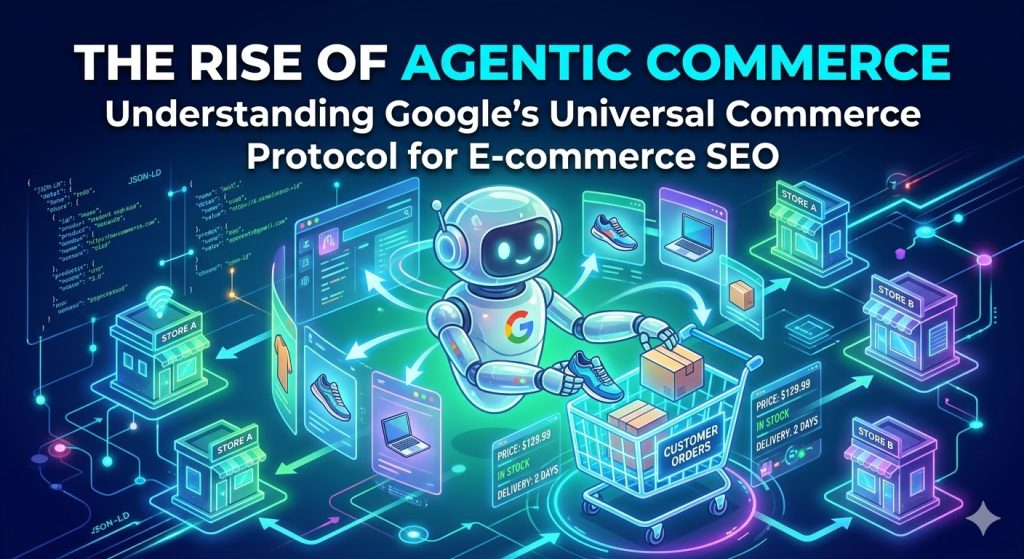
For the past two decades, e-commerce optimization has centered on encouraging users to visit landing pages and manually add items to their carts.
But in 2026, the buyer journey is undergoing its most radical transformation yet. We are entering the era of Agentic Commerce—a reality where AI agents do the shopping for us. And with the rollout of Google’s Universal Commerce Protocol, the way your online store communicates with these agents is now the most critical SEO factor for your bottom line.
If your e-commerce SEO strategy still relies on traditional keyword rankings and human-focused landing pages, it is time to adjust. Here is what you need to know about agent-driven shopping and how to prepare your brand.
What is Agentic Commerce?
Agentic commerce is a shopping ecosystem where autonomous AI agents, such as advanced versions of Google Assistant, Gemini, or third-party AI shoppers, make purchasing decisions for users.
Instead of searching “best running shoes for flat feet,” a user now instructs their AI agent, “Find and buy me the best-rated running shoes for flat feet, in a men’s size 10, under $150, that can be delivered by Friday.”
The AI agent searches the web, evaluates options, checks inventory, and completes the purchase. The agent is now the customer. Unlike human shoppers, agents do not consider your website’s design, copywriting, or discounts. They prioritize structured, accessible, and immediate data.
Enter Google’s Universal Commerce Protocol
To support this new ecosystem, search engines required a standardized method for AI models to accurately interpret e-commerce catalogs. Google’s Universal Commerce Protocol addresses this need.
This protocol serves as a translation layer between your store’s database and Google’s AI agents. It shifts e-commerce SEO from page-level crawling to feed-level API integration.
The protocol prioritizes:
- Real-Time Accuracy: AI agents need millisecond-level certainty on stock levels, shipping times, and pricing.
- Deep Specifications: Granular product details (materials, compatibility, dimensions) that an AI can use to match a user’s complex parameters.
- Trust Signals: Verifiable aggregated reviews, return policies, and seller ratings.
Why Structured Data Now Trumps Landing Pages
In an agentic commerce world, your product page design is secondary. AI agents do not view your site visually; they process your code.
1. The Merchant Feed is Your New Homepage
Your Google Merchant Center feed and the APIs linking your inventory to search engines are now your most valuable digital assets. If your feed is outdated, missing GTINs (Global Trade Item Numbers), or contains pricing discrepancies, AI agents will bypass your store in favor of competitors with more accurate data.
2. Hyper-Specific Structured Data
Basic producBasic product schema is no longer sufficient. To succeed in agentic commerce, you must implement detailed, nested structured data. Explicitly define:tails (Agents heavily weigh delivery speed)
- HasMerchantReturnPolicy (Agents are programmed to avoid stores with poor return terms)
- Material, color, and size variables as specifically as possible.
3. Entity Optimization Over Keyword Density
AI agents map entities, which are concepts, objects, and their relationships. If you sell a specialized coffee maker, the AI is not searching for the keyword “best coffee maker.” Instead, it checks whether your product entity connects to attributes such as “stainless steel,” “conical burr grinder,” and “SCA certified.” Your product descriptions should be fact-dense rather than simply keyword-rich.
How to Adapt Your E-commerce Strategy Today
Adapting to agentic commerce does not require abandoning your human customers, but it does require upgrading your technical infrastructure.
Here are three steps you can take immediately:
- Audit Your Schema Markup: Use validation tools to ensure your product pages’ JSON-LD structured data is accurate, comprehensive, and current with the latest commerce protocols.
- Optimize for Zero-Latency Inventory: Ensure your inventory management system syncs with search engine feeds in real time. AI agents will lower your store’s trust score if they attempt to purchase items that are out of stock.
- Elevate Product-Level E-E-A-T: AI agents analyze reviews to ensure they make informed choices for users. Encourage detailed, attribute-specific reviews from real buyers to strengthen your product’s authority.
The Bottom Line
Agentic commerce is not a passing trend; it is the logical evolution of artificial intelligence and consumer convenience. By optimizing for Google’s Universal Commerce Protocol and maintaining flawless, structured data, you position your products to be selected by AI agents.