The era of keyword stuffing and basic string-matching has ended. Modern search engines use semantic methods, leveraging Natural Language Processing and AI to interpret search intent. Platforms like Google’s AI Overviews, Gemini, ChatGPT, and Perplexity now rely on entities to drive search results.
If your brand exists only as a collection of URLs, it remains invisible to modern search systems. To ensure long-term visibility, shift from optimizing keywords to establishing structured connections.
The Foundation: Understanding the Knowledge Graph
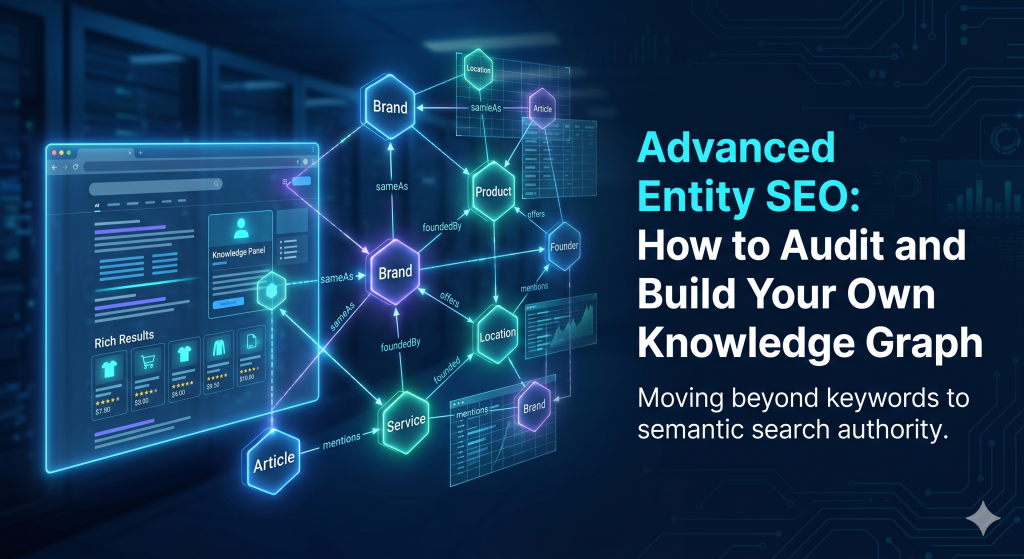
Before building, it is essential to understand the architecture. A knowledge graph organizes data as a dynamic network rather than in rigid tables.
At its core, it relies on two primary components:
- Nodes (Entities): Distinct, identifiable “things” (e.g., a Person, Organization, Location, or Concept).
- Edges (Relationships): The semantic connections between those entities (e.g., foundedBy, locatedIn, or providesService).
When search engines such as Google extract your data, they construct their own knowledge graphs to generate Rich Results, Knowledge Panels, and AI-driven summaries.
Part 1: Auditing Your Current Entity Footprint
Establishing authority requires understanding your current position. An entity audit shows how effectively search engines and language models recognize your brand and its relationships.
1. Map Your Core Entities
Begin by identifying the entities already present on your website. Use tools such as Google Cloud NLP API, InLinks, or WordLift to analyze your top-performing pages. Focus on:
- Brand Entities: Your organization, executives, and proprietary products.
- Topical Entities: The core concepts and industries you claim expertise in.
2. Evaluate Entity Consistency (NAP-W and Beyond)
Inconsistent data disrupts the connections within a knowledge graph. Audit your Name, Address, Phone, and Website (NAP-W) information across:
- Google Business Profile.
- Industry-specific data aggregators and directories.
- Wikipedia and Wikidata (if applicable).
- Authoritative social profiles (LinkedIn, X).
Any variation in your official brand name or core data may cause algorithms to misidentify your entity. Consistency is essential.
3. Check Schema Completeness
Structured data is fundamental to knowledge graphs. Use validation tools to confirm your JSON-LD markup accurately represents your entities. Ensure your Organization schema links to Person or LocalBusiness schemas using @id references to maintain a cohesive graph.
Part 2: Building Your Private Knowledge Graph
A private knowledge graph provides search engines with a structured, machine-readable map of your domain. This reduces the computational effort required for algorithms to verify your authority.
The following steps outline how to build your knowledge graph.
Step 1: Identify and Isolate Core Entities
Compile a definitive list of entities that define your business ecosystem. This should include:
- Organization: The parent company.
- People: Founders, key authors, and subject matter experts.
- Places: Headquarters and specific service areas.
- Services/Products: Every distinct offering treated as its own entity.
Step 2: Define Properties
For each entity identified, specify its properties, such as official URLs, founding dates, social handles, and descriptive attributes. Provide enough unique data points to distinguish your entity from others.
Step 3: Map the Edges (Relationships)
At this stage, establish the semantic relationships between your identified entities.
Step 4: Translate into Schema.org Markup
Translate your conceptual map into detailed, nested JSON-LD schema. Avoid relying on basic plugins; advanced entity SEO requires custom, multi-node markup.
Use the @id attribute to link entities across your site. For example, your blog posts (Article schema) should reference the author (Person schema) via their specific @id URI, tying their expertise back to the Organization.
Step 5: Establish the Master Node
Designate a specific page, such as your homepage or a detailed About page, as the master node. This page should contain your most comprehensive, nested Organization schema, serving as the central reference for all other pages.
Step 6: Validate and Syndicate
After implementation, use Schema validation tools to confirm your code parses correctly. Then, focus on external syndication by earning relevant citations, obtaining mentions in authoritative publications, and expanding your Wikidata presence to strengthen your internal graph.
The Bottom Line
Entity SEO is now essential for visibility in an AI-driven search landscape. By auditing your current footprint and carefully building your knowledge graph, you elevate your brand from a set of indexed keywords to a recognized, authoritative entity.