
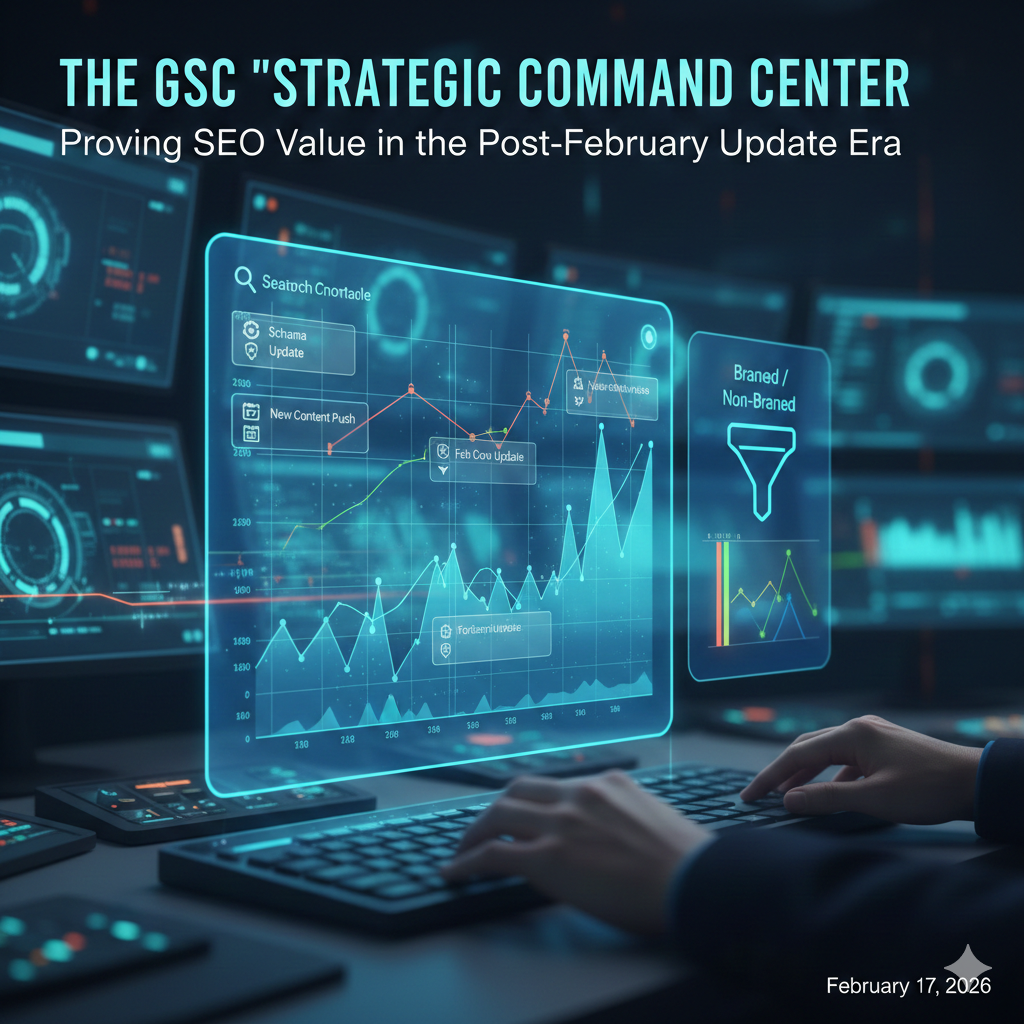
With the February 2026 Core Update now complete, many SEOs face the usual challenges: disorganized spreadsheets, subjective analysis, and manual Regex filters.
This process can be improved. Late last year, Google Search Console (GSC) evolved from a basic diagnostic tool into a Strategic Command Center. With the introduction of Custom Annotations and the AI-Powered Branded Filter, we now have tools to move from simply reporting data to explaining causality.
Here is how to leverage these new features to enhance your Q1 reporting and refine your strategy for the remainder of 2026.
1. Custom Annotations: Addressing the “Why did this happen?” Question
Previously, tracking major site changes required third-party Chrome extensions or complex spreadsheets. This is no longer necessary.
GSC’s native Custom Annotations now let you add notes of up to 120 characters directly to the performance graph. Volatility: Don’t just mark “New Content.” Mark “Fixed Schema on Category Pages” or “Switched to Edge Caching.”
- System vs. Custom: GSC now overlays System Annotations, such as the February Core Update rollout dates, with your Custom Annotations. If traffic declined before the update but aligned with a JavaScript deployment, you can clearly identify the cause for your client.
- The 500-Day Rule: Notes expire after 500 days. Use them for tactical analysis, and maintain a separate permanent log for long-term historical data.
2. The Branded Filter: Moving Beyond the “Regex Hack”
A longstanding challenge in SEO has been distinguishing brand equity from SEO performance. Previously, complex Regex filters were used to exclude brand terms, often missing typos or sub-brands.
The new Branded Queries Filter uses Google’s internal LLM to automatically categorize searches. It recognizes misspellings, product-specific terms such as “iPhone” for Apple, and foreign language variations.
How This Impacts Your Strategy:
- Demonstrating “Pure” SEO Growth: By selecting “Non-Branded,” you can show stakeholders the extent of new, previously unaware audience acquisition. This is a key metric for topical authority.
- The Brand Halo Effect: After the February Core Update, many sites experienced an increase in Branded Search while Non-Branded remained stable. This suggests Google’s “Experience” signals are effective, as users search for your brand after seeing it in an AI Overview.
- Identifying Cannibalization: If non-branded traffic declines while branded traffic increases, your content may be too narrowly focused, serving existing audiences but missing new prospects.
3. The 2026 “Value Proof” Framework
If you are preparing your monthly report on February 17, use this framework to demonstrate your value:
Causal Impact | Custom Annotations | “This 15% lift wasn’t a fluke; it started 48 hours after our internal linking sprint.” |
Market Share | Non-Branded Filter | “We are winning 20% more ‘generic’ industry queries than last month.” |
Brand Authority | Branded Filter | “Our ‘Experience’ signals are working; users are now searching for us specifically.” |
The Bottom Line
In 2026, being an SEO expert is not only about increasing clicks; it is about shaping the narrative. By integrating these native GSC features, you move from simply monitoring rankings to explaining business growth.