
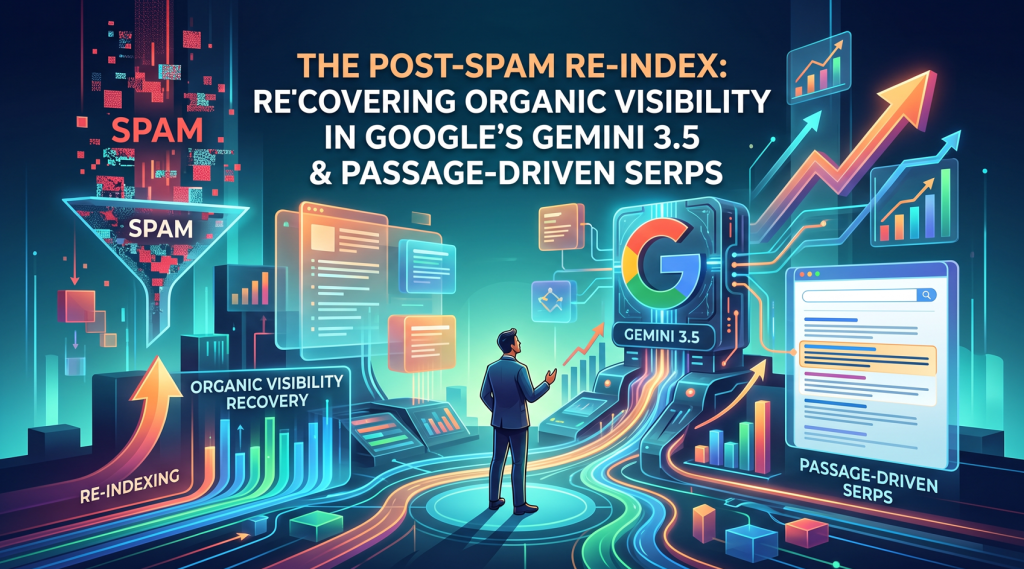
Recent search volatility has subsided, exposing significant changes in the SERP landscape. After the August 2026 Spam Update, which saw 16.71% of top 10 URLs drop beyond position 100, enterprise SEOs must now address the broader rollout of Gemini 3.5 Flash-Lite in Google’s generative search features.
With AI Overviews exceeding 2.5 billion monthly users and AI Mode surpassing 1 billion, optimizing only for traditional “blue link” positions is no longer adequate. Success in Q4 2026 requires understanding Google’s shift to passage-level retrieval, adapting to updated brand signal filters, and structuring content for the “Proof-First” approach in AI Search.
Deconstructing Mid-September Volatility: Spam vs. Passage Ranking
The significant ranking disruption in late August and September was not a typical core update but a structural purge. Google’s spam filters targeted “AI-overfitted” content and programmatic bloat, while increasing reliance on passage-level relevance for generative answers.
When users engage with AI Mode, the Gemini model applies a “query fan-out” technique, breaking complex questions into related sub-queries and processing them simultaneously. The model uses passage-level retrieval instead of page-level ranking, seeking self-contained, highly relevant text passages—often from H2 or H3 sections—that directly address specific aspects of the query.
Pages with lengthy introductions before presenting key information are unlikely to be selected for generative answers. Additionally, Google’s mid-September changes penalize domains that lease authority to third-party subdirectories, ensuring AI Mode citations prioritize verified, first-party entity connections.
The “Proof-First” Content Framework for Q4 2026
To succeed with passage-driven AI retrieval and prevent automated spam demotions, enterprise teams should restructure core landing pages using a “Proof-First” methodology:
- Front-Loaded Quotability (The 100-Word Rule): Begin each major section with a clear, definitive answer. Present your conclusion or primary definition within the first one or two sentences after the heading, then elaborate in subsequent paragraphs. AI models extract self-contained text blocks; answers buried deeper are often ignored.
- First-Hand Evidence Injection: The August spam purge demonstrated that relying solely on synthesized web content is a liability. Incorporate proprietary metrics, original customer case data, technical screenshots, and documented processes that cannot be replicated by generative scrapers.
- Entity Node Wiring: Move beyond basic keyword mapping. Use deeply nested JSON-LD schema to interlink about, mentions, and author properties, explicitly aligning on-page passages with recognized Knowledge Graph entities. This approach clarifies intent for Google’s semantic parsers.
- Modular Heading Architecture: Format HTML tags to reflect logical query structures. Use declarative, question-shaped, or claim-shaped H2 and H3 headings to ensure content sections align with Gemini’s query fan-out behavior.
Diagnostic & Recovery Protocol
If you have experienced traffic declines in the past six weeks, identify the specific failure point before revising your site architecture:
- GSC Generative AI vs. Organic Segmentation: Separate traditional organic performance data from Search Console’s Generative AI reports. A decline in traditional clicks may result from “zero-click displacement,” where an expanded AI Overview moves your top organic link below the fold, rather than actual index suppression.
- Content Pruning vs. Restructuring: Identify “Information Echoes.” Multiple thin pages targeting similar intents are vulnerable to spam classification. Consolidate these into a single, authoritative, passage-rich primary URL that serves as a definitive resource.
- Technical Crawl Hygiene Check: Ensure all critical rendering pathways are fully accessible. Gemini-based crawlers require clean, static HTML for efficient passage extraction. Content hidden behind extensive client-side JavaScript may be bypassed.
Looking Ahead to Q4
High-volume, generic AI content is consistently losing visibility. To secure search visibility through the end of 2026, deliver structured, evidence-based authority in modular, easily parsable formats.
Immediate Action Checklist:
- Audit your top 30 organic revenue-driving pages to ensure passage-level independence and clear, front-loaded quotability.
- Isolate traffic declines in GSC by comparing organic SERP positions with AI Overview impressions to distinguish between actual demotions and user interface displacement.
- Ensure all first-party author and organization schema are fully validated and properly nested.
Expert Value-Add Tip
If you notice discrepancies between Google Search Console click data and Google Analytics 4 sessions for mobile traffic, this may result from Google’s expanded use of intermediate [google.com/goto](https://google.com/goto) redirect wrappers on AI Overview links. Instruct your technical teams to review GA4 referral attribution filters to ensure this mobile traffic is not incorrectly categorized as “Direct.”