
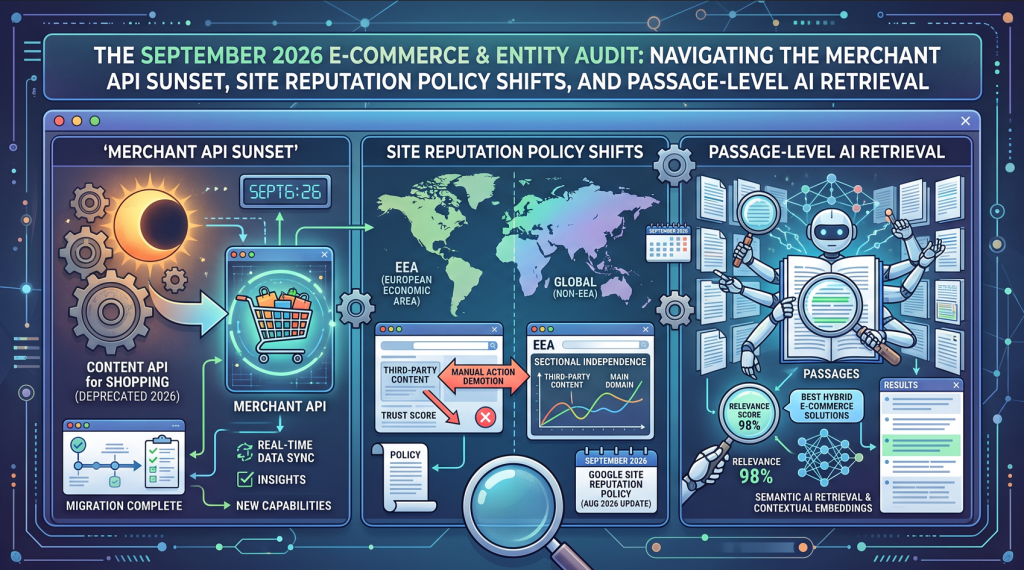
The September 2026 E-Commerce & Entity Audit: Navigating the Merchant API Sunset, Site Reputation Policy Shifts, and Passage-Level AI Retrieval
Core Focus
This post skips basic advice and speaks directly to enterprise SEOs, agency directors, and technical leads managing high-scale e-commerce or publishing operations. It breaks down the technical impact of the September 1 Content API sunset, analyzes regional enforcement changes to Site Reputation Abuse policies, and introduces an actionable Passage-Level Entity Optimization (PLEO) framework to capture citations as Google expands dynamic AI Overviews into full AI Mode carousels.
Detailed Outline
I. Introduction: The September Technical Clean-Up
- The News: Document the September 1 cutoff of the legacy Content API for Shopping (410 Gone HTTP status responses) and the August 30 policy shift in European Site Reputation Abuse enforcement.
- The Fallout: Review late-August SE Ranking data showing an 82% surge in top-10 ranking drops following the August Spam Update. Emphasize that Google’s SpamBrain classifier actively penalizes programmatic e-commerce bloat and host-domain authority leasing.
- The Thesis: Winning Q4 2026 requires eliminating legacy API debt, auditing sub-directory reputation dependencies, and structuring page content for modular passage-level retrieval in dynamic AI Overviews.
II. E-Commerce Critical Fix: Navigating the Merchant API & 410 Gone Errors
- The Sunset Impact: Explain what happens when legacy e-commerce feeds trigger 410 Gone errors causing silent indexing drops in Google Shopping carousels and organic rich product snippets.
- Migration Audit Protocol: How technical teams must audit Google Merchant Center integrations, migrate to the Merchant API, and ensure structured Product JSON-LD schema reflects real-time stock levels and price variations dynamically.
- Schema Validation: Verifying that product variants and canonical endpoints avoid canonical-loop errors under Google’s updated September rendering engine.
III. The European Policy Pivot: Deconstructed Site Reputation Abuse
- The Shift: Analyze Google’s August 30 policy change regarding Site Reputation Abuse manual actions inside the European Economic Area (EEA).
- Direct vs. Independent Ranking Impact: Outside the EEA, host domains face blanket manual actions for leasing subdirectories (e.g., commercial coupon/review sections run by outside entities). Inside the EEA, Google’s systems programmatically sever the host domain’s reputation from the leased section, forcing the third-party section to rank on its own merits.
- Enterprise Risk Assessment: Why global brand managers must audit white-label subdirectories, external licensing deals, and third-party commercial hubs immediately before non-EEA manual actions spread to international properties.
IV. Passage-Level Entity Optimization (PLEO): Capturing Dynamic AI Overviews
- The Mechanism: Detail how Google’s dynamic AI Overviews extract self-contained text blocks (“passages”) to populate AI Mode carousels mid-session.
- The Modular Writing Framework: How to write for “passage-level independence” ensuring that individual H2/H3 sub-sections contain a complete entity definition, primary proof signal, and declarative conclusion an LLM can parse and cite independently of the broader page layout.
- The “Quotability” Metric: Evaluate whether a 150-word section of a 2,500-word guide can be extracted as a standalone, self-sufficient answer for conversational search.
V. Conclusion & The September Execution Checklist
- Reiterate that technical precision (API compliance, clean site boundaries) combined with passage-level entity clarity forms the baseline for Q4 search performance.
- Immediate Checklist:
-
- Audit all Merchant Center feed pipelines to eliminate 410 Gone responses from legacy Content API calls.
- Review white-label content sections and third-party partnerships against updated Site Reputation Abuse guidelines.
- Run a passage-level audit on top 20 revenue-driving informational pages to ensure key answers are formatted in declarative, easily-parsable HTML blocks.
Target Keywords
- Primary: Google Merchant API migration SEO, passage-level entity optimization, Site Reputation Abuse policy September 2026
- Secondary: Content API for Shopping 410 error fix, August spam update recovery data, dynamic AI Overviews optimization, enterprise SEO audit September 2026.
Expert “Value-Add” Tip for the Post:
Remind your technical readers to check their server logs for google.com/goto redirect tracking. In late August 2026, Google expanded redirect wrappers for certain organic search links. If your analytics team notices a sudden jump in “Direct” traffic with a matching drop in “Organic Search” for specific mobile queries, it may be caused by stripped referrers during the goto redirect loop. Advise them to update their GA4 data filters to properly attribute user sessions originating from these Google-controlled intermediate endpoints!